

Overview
Trading fees are the costs you pay when you buy, sell, or trade on an exchange. On Orderly, fees are measured in basis points (1 bps = 0.01%) of your trade’s total value. Orderly Network uses a two-layer fee structure:- Base fees: The cost the Builder (the DEX) pays to Orderly Network.
- User fees: The fee the Trader pays to the Builder.
The dual-layer example
Here’s how the two layers work together in practice:- Orderly base taker fee: 3 bps (0.03%)
- Builder custom fee: 5 bps (0.05%)
- Result: The Trader pays 5 bps. Orderly retains 3 bps, and the Builder keeps 2 bps as profit.
Fee types
Maker fees: Charged when your order adds liquidity to the order book — for example, a limit order that doesn’t fill right away. Maker fees can be negative (rebates) for higher tiers, meaning you receive a rebate when your order adds liquidity. Taker fees: Charged when your order removes liquidity by filling immediately — for example, a market order. Hidden order fills: When hidden quantity from a resting limit order is matched by a new incoming order, the hidden side is marked as Taker and charged the taker fee. If the incoming order is eligible to be maker, such as a Post Only order that matches only hidden quantity, the incoming order is marked as Maker and charged the maker fee. Liquidation fees: If your position gets liquidated, a liquidation fee is applied. See the liquidation fee docs for details.Perpetual futures trading fees are charged after every trade in USDC and are factored into the
position’s average entry price.
How fees work for Traders
As a Trader, you pay a single fee per trade that’s set by the Builder (the DEX you’re using).- Total fee paid: You see one transparent fee per trade. This fee typically includes Orderly’s base fee plus the Builder’s margin.
- How it’s charged: Fees are automatically deducted from your USDC balance when your trade executes.
- Maker vs Taker: Whether you pay the maker or taker rate depends on how your order is filled. If your order sits in the book and waits, you’re a Maker. If it fills immediately, you’re a Taker.
How fees work for Builders
Orderly gives Builders full control over their pricing. You set your own trading fees while tapping into Orderly’s shared liquidity.- Set your own fees: You decide what to charge your users. The only rule: your fee must be at least as high as Orderly’s base fee.
- Keep your fee margin: For taker fees, you retain 100% of the margin between what you charge users and what Orderly charges you. For maker fees, positive fees collected from traders are Builder revenue. Protocol-funded maker rebates are passed through to traders and are not Builder revenue.
- Base fee tiers: The base fee Orderly charges you depends on your tier in the Builder Staking programme.
Builder Staking programme
Builders can get lower base fees and better support by hitting monthly volume targets or staking $ORDER tokens. If you qualify for different tiers through both volume and staking, you automatically get the higher tier (lower fee). Builders are entitled to the same Orderly base fees regardless of whether trades are on crypto or RWA markets. Builders can still configure different user-facing trading fees for crypto and RWA trades respectively.- Overview
- Public
- Silver
- Gold
- Platinum
- Diamond
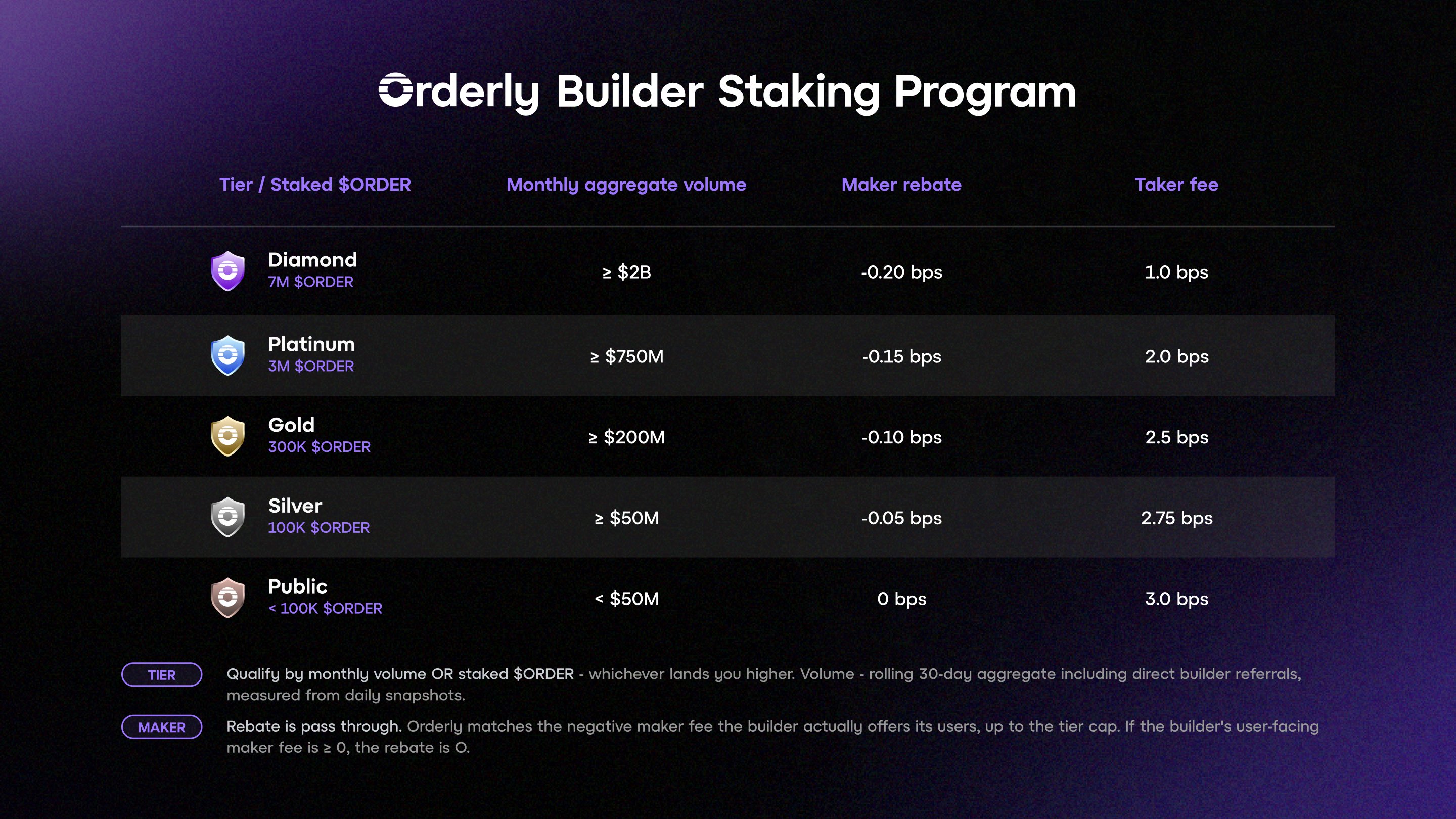
Fee tier notes:
- Volume calculation: Monthly aggregate trading volume includes all activity from the Builder and their direct Builder referrals, calculated from daily snapshots to determine tier eligibility.
- Minimum tier assignments: Minimum tiers may come from the distributor program or internal strategic assignments. They act as a floor, but builders can still move to higher tiers through staking or volume at the next daily refresh.
- Conditional maker rebates: The negative maker rate for Silver tier and above is a cap on the rebate Orderly will fund when the Builder passes a negative maker fee through to the trader. Orderly funds no rebate when the trader’s maker fee is zero or positive. The funded rebate belongs to the trader and is not Builder revenue. See Conditional Maker Rebates for examples.