Orderly takes 30% of its net fees to buy our token, $ORDER, on the open market and hand that $ORDER to the people who staked. Staking rewards are not new emissions or a points program. They are fees the protocol already collected, spent on the token, and routed to holders.
The rest of this post is how that works, what governance has changed, and why the system is built to make impatience expensive.
What It Is
$ORDER is the native token of the Orderly protocol. Max supply 1,000,000,000. It is live on numerous chains via LayerZero's OFT standard, which is why you can stake on one chain and claim on another.
Builders run the 400+ DEXs drawing on Orderly’s orderbook. Traders on Orderly DEXs generate the volume that generates the fees. Holders of $ORDER can stake.
Staking does 3 core things: it earns VALOR (rewards), it carries governance weight, and if you're a builder it sets the fee tier your venue trades at.
The first one is the core of the system. The last one is the one that scales builders.
VALOR Is the Actual Mechanism
VALOR is not a token. You can't buy it, sell it, or move it. It's a non-transferable measure of your staking position. When you redeem VALOR for treasury assets, that VALOR is burned. Permanently.
Your claim is simple arithmetic. Your available VALOR divided by circulating VALOR, multiplied by the treasury. Circulating VALOR is everything emitted so far minus everything redeemers have burned.
Read that denominator again, because it's the part people miss. Every time someone else cashes out, your share of the treasury goes up. The exit door pays the people standing still.
Where the Money Comes From
30% of Orderly's net fees accrue to the staking treasury daily and settle as an $ORDER buyback at the end of each epoch. Redeem VALOR, wait out the 7-day settlement window, and you receive esORDER.
esORDER, and the Part That Costs You
esORDER is escrowed $ORDER. Vesting is where the system charges you for being in a hurry:
| Option | Duration | You receive |
|---|---|---|
| Minimum vesting | 15 days | 50% |
| Maximum vesting | 90 days | 100% |
The remaining half unlocks linearly between day 15 and day 90, and you get one claim inside that window.
Whatever you don't wait for is burned. Take 100 esORDER out at day 15 and you get 50 $ORDER. The other 50 doesn't go to a treasury, a foundation, or a marketing budget. It's destroyed, and every remaining holder's slice of a fixed 1B supply gets marginally larger.
Why Impatience Can Be Expensive
Orderly's docs run an example worth restating, because it's the cleanest illustration of the whole design.
Alice and Bob each stake 1% of supply on day one. Same position, same VALOR, same treasury share of $5,000 at the end of an epoch. Bob redeems 60,000 VALOR and takes $1,875 out.
One epoch later, after new revenue lands, Alice's remaining VALOR is worth $7,503. Bob's is worth $5,359. Add back the $1,875 he already pocketed and Bob is at $7,234.
Alice made $269 more for doing nothing at all.
The Other Reason to Stake: Builder Fee Tiers
Everything above is the holder's case. There's a second one, and it's pointed at the 400+ teams running venues on Orderly.
The Builder Staking Program sets your DEX's fee tier by monthly volume or staked $ORDER - whichever lands you higher.
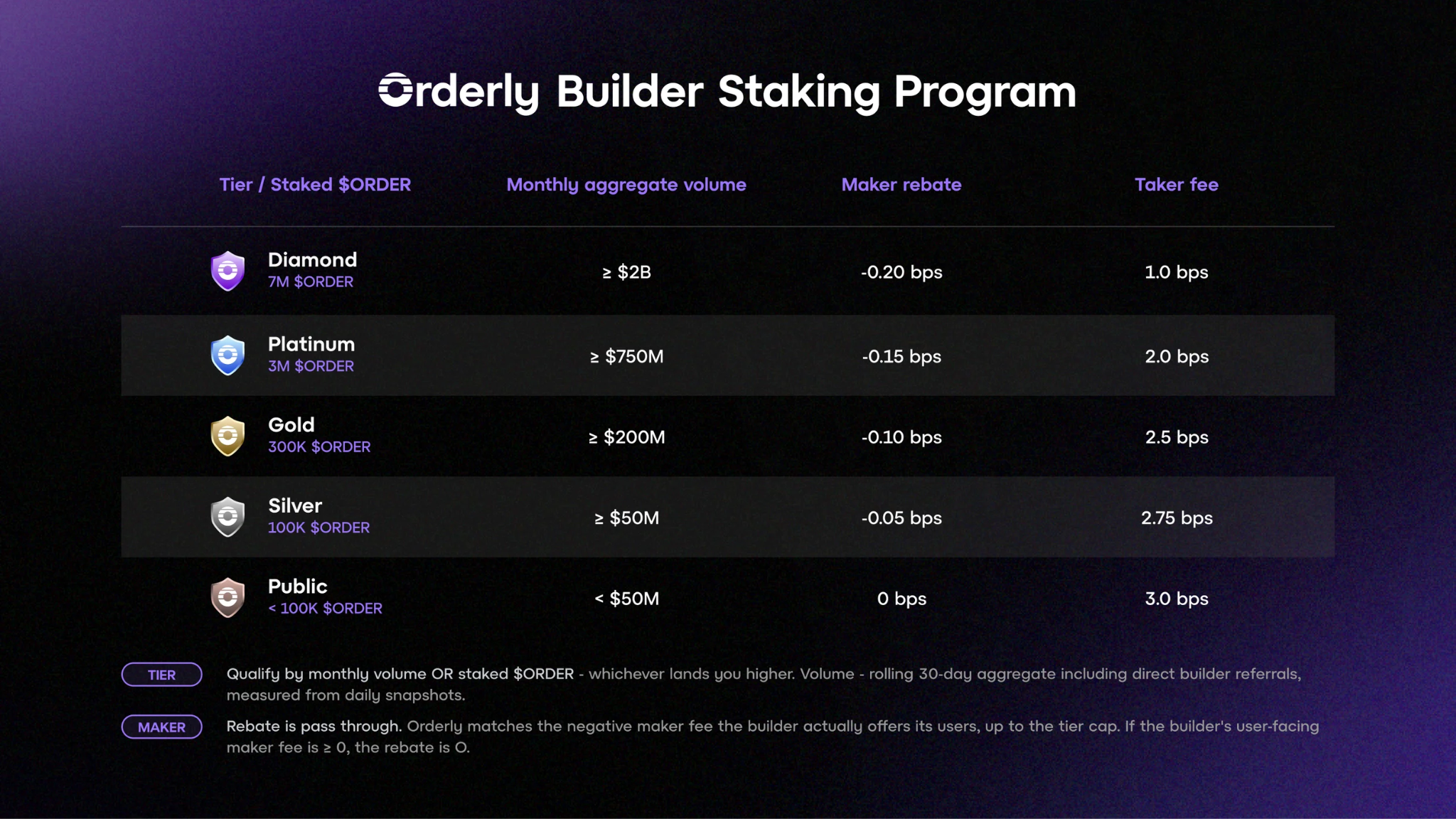
Volume is a rolling 30-day aggregate measured from daily snapshots. The maker rebate is pass-through: Orderly matches the negative maker fee you actually offer your users, up to your tier cap. Set your user-facing maker fee at zero or above and the rebate is zero.
Read the or again, because that's the whole design. Volume is earned slowly and can't be bought. A tier can. With $ORDER, a venue that launched last week can hold the fee economics of one doing $2B a month.
Now the part that matters. Moving from Public to Diamond takes your taker cost from 3.0 bps to 1.0 bps. You get two things to do with that 2 bps, and you have to pick:
Pass it through. Undercut every other venue drawing on the same orderbook. Identical depth, identical execution, cheaper for your users. When every venue shares an orderbook, price is one of the few surfaces you actually control.
Keep it. Leave your user-facing fee exactly where it is and widen your own take by 2 bps on every taker dollar. Nothing about your product changes and nothing about your users' experience changes. Your margin does.
Most builders will split the difference. The point is that the gap between what Orderly charges you and what you charge your users is a dial, and staked $ORDER is what turns it.
The arithmetic is unusually direct. At $100M in monthly volume, the distance between Public and Diamond is roughly $20,000 a month in taker fees alone. At $500M it's $100,000.
And the tokens are still staked. They're still accruing VALOR every second, still holding a claim on the treasury, still boosting your rewards. You aren't spending capital to buy a fee tier. You're posting it, and it keeps working while it sits there.
The Numbers, Right Now
- Over 91,000,000 $ORDER staked - roughly 23% of circulating supply locked into the VALOR machine
- Over 4,000 active stakers
- More than 11,000,000 $ORDER bought back with protocol fees
- A whopping 5,411,080 $ORDER burned
How to Stake
- Open app.orderly.network/staking and connect your wallet.
- Stake. VALOR accrual starts the second the transaction confirms.
- Redeem VALOR whenever you want, partial or full. All redemptions in an epoch settle at the same price at batch close.
- Claim your esORDER after the 7-day window. It auto-stakes.
- If you ever want out, unstaking runs 7 days, can be cancelled at any point, and doesn't touch the VALOR you've already earned.
Watch which chain you're connected to when you redeem. Your rewards are claimable on that network and the choice can't be changed afterward.
Who This Is For
- Traders on any of the 400+ Orderly DEXs, whose fees fund the treasury either way, staking is the difference between paying into it and owning part of it
- Builders, your venue generates the net fees the whole mechanism runs on, and staking sets the fee tier you run it at
- Anyone who wants a token with real buyback mechanisms
The Loop Is the Point
Volume produces fees. Fees buy $ORDER. $ORDER goes to stakers as esORDER. esORDER auto-stakes and earns more VALOR. Impatience burns supply and pays whoever is left.
There is no step in that sequence where new tokens are printed to make the yield look bigger. The only inputs are trading volume and time.
Stake $ORDER · Read the tokenomics docs · Create your DEX
FAQ
What is $ORDER? The native token of the Orderly protocol, capped at 1 billion supply. Staking it earns VALOR, which entitles you to a share of the protocol treasury, plus boosts on trading and market making rewards, weight in governance, and fee tiers for builders.
How does builder staking affect fees? Your venue's tier is set by rolling 30-day volume or staked $ORDER, whichever is higher. Tiers run from Public (3.0 bps taker, no maker rebate) to Diamond at 7M staked $ORDER (1.0 bps taker, -0.20 bps maker rebate). You can pass the difference to your users as lower fees or retain it as margin.
Is the maker rebate automatic? No. It's pass-through. Orderly matches the negative maker fee you actually offer your users, capped at your tier. If your user-facing maker fee isn't negative, the rebate is zero.
How much revenue goes to stakers? 30% of Orderly's net fees, accrued daily and settled as an $ORDER buyback at the end of each 14-day epoch.
What is VALOR? A non-transferable measure of your staking position. It's the only way to claim treasury assets, and it's burned when redeemed.
What is esORDER? Escrowed $ORDER. It stakes exactly like liquid $ORDER, or vests back into $ORDER over 15 to 90 days at a 50% to 100% conversion rate.
What happens if I vest esORDER early? The unconverted portion is permanently burned and removed from supply.
How is staking APR calculated? Trailing 7-day average daily returns, annualized. Daily returns are 30% of protocol daily net revenue divided by the USD value of total staked $ORDER and esORDER. Past performance doesn't guarantee future returns.
Can I stake on one chain and claim on another? Yes. Staking data is chain-agnostic across a given EVM address. Only your wallet balance is network-specific.